The Spirit of Baraka celebrates nonverbal films such as
Baraka, Koyaanisqatsi and the people who
made them. All of the films featured on this web site offer something different
to regular movies. The films have no plot, no actors and no script
but instead contain images from around the world.
Baraka is now available on Blu Ray DVD
Baraka has finally got a Blu Ray transfer, allowing the film to be seen in the quality that it was intended.
A unique 8K ultradigital transfer system was developed especially for Baraka to capture it to Blu Ray
The new release includes 80 minutes of new bonus features
Baraka (1992) is a film containing images of
landscapes, cultures, monuments and people from around the world. The most
popular of the nonverbal films here. Filmed on very high quality
70mm. Created by Ron Fricke, and now with an excellent DVD transfer
Koyaanisqatsi (1983) was the first film in the
nonverbal genre, and remains one of the most popular. Provoking images of the
northern hemisphere are presented in an inspiring manner. Emulated in part by
most films here. Directed by Godfrey Reggio, shot by Ron Fricke.
Winged Migration (2001) is the latest film from the
Microcosmos team. Amazing up close images of migrating birds, expertly shot.
Beautiful landscapes scenes also. Winged Migration is recommended for
fans of Microcosmos. Now re-released at a cheaper price.
New films
Dogora (2004) is a brand new film
featuring the people of Cambodia, and their daily lives. The images are
stunning and the subject fascinating. Dogora is recommended for fans of Baraka,
Koyaanisqatsi and Powaqqatsi.
The 8th Annual Tiburon International Film Festival (TIFF) will be held March 19-27, 2009 in Tiburon, California, a showcase for the independent films and filmmakers from around the world.
Submissions are open to all genres of film: Fiction, documentary, short, animation, experimental, student, children, sports, music video.....from any nation in the world.
The festival has honored many great filmmakers: Orson Welles, Sam Pekinpah, Luchino Visconti, Charlie Chaplin, Santiago Alvarez, John Frankenheimer, George Stevens, Malcolm McDowell, Saul Zaentz, Brad Bird, Paul Mazursky, Mark Rydell, Blake Edwards .....
The Tiburon International Film Festival is proud to be a platform for the independent filmmakers from around the world, with premieres like Academy Award winner"West BankStory" by Ari Sandel, and Academy Award nominee"Salim Baba" by Timothy Sternberg .... and many films, which have been picked up for distribution .... and or invited to other festivals after premiering at TIFF.
Golden Reel Award
The films submitted to the Tiburon International Film Festival are eligible to win the "Golden Reel Award" in several categories: Best Fiction, Best Documentary, Best Director, Best Screenplay, Best Short, Best Animation, Best Children Film, Best Student Film, Best Music Video, Best Sport Film .....and the winners of all categories will be announced during a formal ceremony at the end of the Festival.
Entry Information:
Entry form and eligibility guidelines are available by clicking here, or on the festival website under Submit Films.
Deadlines:
Early Bird: November 17, 2008
Late: December 15, 2008
Grant Wakefield has released a preview to this latest work, Empire of Stone, which is part of his Remnants project. It's a great timelapse film, 15 minutes in length. We look forward to seeing more of the project.
Watch a trailer of Highway World, Martin Hans Schmitt film currently doing very well on the film festival circuit. It's also available to buy from Amazon (links below).
“the finest video disc I have ever viewed or ever imagined”
“’Baraka’ by itself is sufficient reason to acquire a Blu-ray player.”
If man sends another Voyager to the distant stars and it can carry only one film on board, that film might be "Baraka." It uses no language, so needs no translation. It speaks in magnificent images, natural sounds, and music both composed and discovered. It regards our planet and the life upon it. It stands outside of historical time. To another race, it would communicate: This is what you would see if you came here. Of course this will all long since have disappeared when the spacecraft is discovered.
The film was photographed over 14 months by director Ron Fricke , who invented a time-lapse camera system to use for it. In 1992, it was the first film since 1970 to be photographed in Todd-AO, a 65mm system, and in 2008, it seems to have been the last. The restored 2008 Blu-ray DVD is the finest video disc I have ever viewed or ever imagined. It was made from the Todd-AO print, which was digitally restored to a perfection arguably superior to the original film. It is the first 8K resolution video ever made of a 65mm film, on the world's only scanner capable of it. It is comparable to what is perceptible to the human eye, the restorers say. "Baraka by itself is sufficient reason to acquire a Blu-ray player.
The film consists of awesome sights, joyful, sad, always in their own way beautiful. By that I do not mean picturesque. A friend came into the room while I was watching the film, saw a closeup of the head of a Gila monster and said, "That's beautiful." I asked if she liked lizards. "I hate lizards," she said, shuddering. She wasn't thinking about lizards. She was observing the iridescent scales of the creature's head. Beauty is in the eye of the beholder. We are the beholder.
A large gathering of men, shaped in a rough circle, join in synchronous dancing, bowing, standing, kneeling, sitting, standing, their arms in the air, their fingers fluttering like the wings of birds, their voices a rhythmic chatter. Asia, somewhere. They face a statue of the Buddha. Their movements are more complex and intricately timed than the drummers at the opening ceremonies of the Beijing Olympics. More inspiring, also, because they have chosen to do this as worship and have not been drilled. They have perfected their ritual, and in their faces we do not see strain or determination, despite the physical ordeal, but contentment and joy. Their movements have the energy of deep enjoyment.
There's the indescribable beauty of aborigines, their bodies bearing necklaces, bracelets and body ornaments made from countless tiny beads, their arms and faces painted in intricate patterns of innumerable dots. They dip a cheap plastic comb in paint and rotate it across their skin to leave the dots. Their hypnotic dancing somehow reverberates with the Asian dancers. We see the bright scarlet paint on the brow of a young Amazonian girl, peering solemnly from bright green leaves. A young woman of the Maasai tribe in Kenya, is clothed in a beauty to render "designer fashions" threadbare.
More images: the sorrowful fall in slow motion of an ancient and lofty tree in the rain forest. The sad poetic beauty in slow motion of a chain of explosions for a strip mine. The despoiling of the land by the deep mine pits. The undeniable beauty of the access roads circling down to the pit bottoms, one line atop another. A virgin forest seen from high above, looking down on wave after wave of birds, hundreds of thousands of them from horizon to horizon.
Scavengers, in an enormous garbage dump in India, claw at the refuse to make a living, competing with birds and dogs. Women, boys and girls. Barefoot. Bold boys climb atop a dump truck to slide down with fresh garbage and grab at treasure. There's not a T-shirt to be seen. They are all garbed in the cheapest fabrics of India, a land where a woman can crawl from a cardboard box on the sidewalk and stand up looking elegantly dressed.
Eggs, thousands of them, float by on a conveyor belt. Recently hatched chicks, dressed in yellow down, tumble from a conveyor belt down a chute onto another belt. Their eyes are wide, they look about amazed, their tiny wings flutter. This is the most freedom they will ever know. They are sorted, tossed into funnels, spin down in a spiral, emerge one at a time to be marked with dye and have the tips of their beaks burned off. This process, one second per chick, is repeated time after time by workers. Endless rows of chickens stacked atop each other in boxes too small to allow them to move. Girls and young women, thousands of them, as far as the eye can see, make cigarettes by hand in a South American sweatshop. Too close to stretch. Workers assemble computer parts in a Japanese factory, thousands of them, each one repeating a small action all day along, one who is working with a bandaged hand, three of its fingers too short.
In the factories, the high-angle camera shows rows of these workers reaching to the vanishing point. These are not computer graphics. The images result from painstaking care and perfectionist detail in the filming and restoration, and thoughtful camera placement. Consider a shot from above looking down on the great hall of Grand Central Station. Two movements at once: commuters dashing across the floor in speeded-up time, while the camera pans across them in slow motion. It is easy enough to achieve fast motion, but how difficult with a camera that is panning with exquisite slowness. There's an overhead shot of an intersection in Tokyo, with alternating swarms of thousands of cars and thousands of pedestrians. Escalators on the subway system, a speeded-up shot, pour out travelers as the conveyor belt poured chicks.
An orangutan stands shoulder-deep in a warm pool, steam rising around it. We regard it. The eyes look old and thoughtful. The sky is filled with stars. The same thoughtful eyes again. What is it thinking? W.G. Sebold: "Men and animals regard each other across a gulf of mutual incomprehension." What are the people thinking? The man waits for a light to change in Tokyo, inhaling his cigarette. Prostitutes gather outside their brothel. Steelworkers are covered with grime. Monks, girls at a subway stop, kabuki dancers. Why does no one make eye contact with the camera during crowded street scenes? Where was the big Todd-AO camera? How was it concealed? Why did it not frighten a herd of springboks, standing at rest in perfect focus?
Will the aliens viewing this film comprehend some of the scenes? Tiny bright plumes in a desert are revealed as the burning oil fields of Kuwait. Mothballed B-52 bombers reach to the horizon. Manhattan. Corpses are burned on the banks of the Ganges. Will they know the donkeys are pulling a cart much too heavy for them? They will probably understand mountains, waterfalls, volcanoes. Do we? "Baraka is paced so we can contemplate the places we will never go, the places we are destroying, the places where we might find renewal. It is like a prayer.
"Baraka is a Sufi word meaning "a blessing, or the breath, or the essence of life, from which the evolutionary process unfolds." In Islam generally, it is "a quality or force emanating originally from Allah but capable of transmission to objects or to human beings." In Judaism, it is a ceremonial blessing. In Swahili, it means "blessing." In French slang, it means "good luck." In Serbian and Bulgarian, it means "shack." In Turkish, it means "barracks." All over the world, it is the name of a character in the "Mortal Kombat" video game.
A PAL region 2 DVD of Lucky People Center International will be released in Jan/Feb next year in Scandinavia. It is the first time LPCi will be released on DVD with english subtitles (it will also have swedish, danish, norwegian and finnish subtitles).
It also contains a new 5.1 sound mix as well as the orginal 2.0 mix.
Hopefully it will be available worldwide eventually.
Baraka is expected to be released on Blu-ray on 28-Oct-2008.
You can pre-order the Blu-Ray with a link at the top of the Baraka page
"FULLY RESTORED - THE FIRST MOVIE EVER TRANSFERRED IN 8K ULTRADIGITAL HD!"
Special Features: Includes over 80 minutes of all new bonus features: Baraka: A Closer Look
Baraka: Restoration
It's expected to sell for US$34.98.
Great news as Baraka is truly a film that will benefit from a high quality transfer, as it was shot in 70mm. Currently Baraka DVDs are difficult to get hold of, and I assume it is because production and release has stopped whilst the Blu-Ray HD version was published. I expect a new DVD version will also be available.
I might have to buy a new TV and DVD player soon :)
I'll let you know more when I get more information.
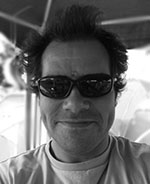
Mark Magidson has kindly sent a photograph from Sossosvlai, Namibia, where he is currently filming Samsara. He expects to be in Africa for 6 weeks. I hope to have more photographs from Mark soon
Martin has sent me a copy of his film Highway World. It is a great film which fits nicely into the genre of this website. I am about to leave England to spend the winter traveling in India and Southeast Asia, and unfortunately to do not have time to add a page for the film. Check out Martin's website though, and I will add more details upon my return in June.
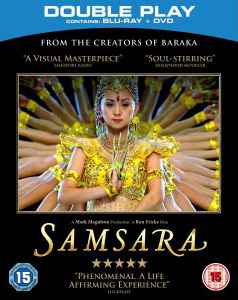
"Samsara," directed and shot by Ron Fricke, has begun lensing and will span 12 to 14 months and more than 20 countries.
From producer Mark Magidson:
"One of the challenges of this is to try to get stunning and unfamiliar imagery. We also need to have a lot of density of imagery to build the sequences for a film that relies on non-verbal storytelling and can sustain interest for the length of a feature."
Lisa Gerrard of Dead Can Dance and "Gladiator" fame will be involved in the "Samsara" score.
Improvements in home- theater systems over the years have helped keep homevid demand strong, and "Baraka" has shipped more than half a million DVDs to date. An upgraded edition, in both regular and high-definition, is on the way from MPI Home Video by year's end.
Budget for the sequel is likely to exceed the original's $3 million, with world distribution rights expected to remain up for grabs until shooting wraps.
The Spirit of Baraka web site was created to inform
people of the existence and availability of these incredible film and to
highlight the amazing work of everyone involved.
I understand and respect the need for copyright with all the images and sources
of information displayed on this web site. If anyone should object to the use
of any materials on this site please contact me and I shall remove/adjust the
content, thanks.